
Dream Impact Cuts Leverage to 36.2% as It Reshapes Its Book
Dream Impact cut its leverage sharply in the first quarter, with debt-to-asset value falling to 36.2% from 43.7% at year-end as the trust settled loans and pushed maturities out.
Dream Impact Trust spent the first quarter doing the unglamorous work of fixing its balance sheet. Debt-to-asset value fell to 36.2% at March 31, 2026, down sharply from 43.7% at year-end 2025, after the trust settled the 49 Ontario land loan and refinanced its way out of near-term pressure per Businesswire. The headline loss widened, but the leverage story is the one that matters here.
| Metric | Value |
|---|---|
| Debt-to-Asset Value | 36.2% |
| 2026 Maturities (Trust share) | $182.1M |
| Cash on Hand (May 1) | $6.5M |
| Rental Occupancy | 94.4% |
Key Takeaways
- Debt-to-asset value fell to 36.2% from 43.7% at year-end 2025.
- 2026 maturities cut by $58.7M since year-end through refinancings.
- Rental occupancy climbed from 86.8% to 94.4% year-over-year.
The Deleveraging Story
Reported May 4, 2026, the quarter showed a net loss of $4.6 million, slightly wider than the $3.8 million loss a year earlier, driven by higher shared service fees, fair value adjustments in the commercial portfolio, and lower condo occupancy income against the prior year's Brightwater completions. But the cash story moved the other way. Settlement of the 49 Ontario land loan helped push debt-to-asset value down to 36.2%, and the trust trimmed its 2026 maturities by $58.7 million since year-end through refinancings. Some $182.1 million in debt at the trust's share still comes due in 2026, with $6.5 million of cash on hand and $21 million of availability under its Dream loan as of May 1, 2026 per moomoo.
The operating book is firming underneath the deleveraging. Multi-family net operating income grew to $3.2 million from $2.6 million a year earlier, and occupancy across the rental portfolio improved from 86.8% to 94.4% year-over-year — the income base management is steering the whole trust toward.
Building Toward a Rental Trust
The refinancing buys time for a portfolio that is still mostly under construction. At 49 Ontario, a 1,226-unit purpose-built rental project, demolition is progressing under long-term construction financing on a 20-year CMHC term; Dream Impact holds a 90% interest with CentreCourt at 10%, and refinancing there is not required until 2046 per RENX. In February 2026 the trust completed a restructuring of the Quayside partnership, taking collective control of 100% of Phase 1's multi-family component on a 25%/75% basis — roughly 1,100 market rental units plus 550 affordable units alongside Waterfront Toronto and the City of Toronto. The five-year plan targets about 2,300 residential rental units by 2030, with multi-family making up roughly 90% of portfolio value and 72% of debt financed through CMHC programs.
The Market's Read
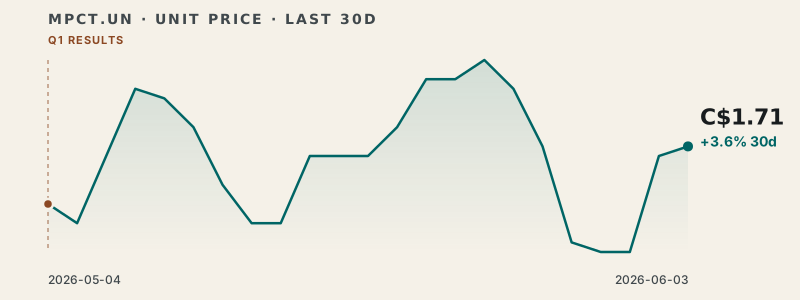
The units have not waited for the development pipeline to deliver, trading around $1.71 in late May, down roughly 42% year-to-date as investors weigh the 2026 maturity wall against a portfolio still years from full stabilization.
What to Watch
- 2026 maturities: Whether the remaining $182.1 million wall is refinanced as smoothly as the $58.7 million already cleared.
- Annual Meeting: Unitholders meet June 3, 2026, where management is expected to address settling the 2026 management fee via convertible debenture.
- Occupancy: Whether the 94.4% rental occupancy holds as more multi-family units come online.
The Bottom Line
Dream Impact's first quarter was a balance-sheet quarter, not an earnings one. The 36.2% debt-to-asset value, down from 43.7%, and $58.7 million of 2026 maturities cleared give the trust room to keep building toward its rental future — even as a $4.6 million loss and a unit price near $1.71 show the market wants proof the pipeline pays off before it re-rates.