Level: Intermediate · Duration: ~15 minutes · Course 1 of 6 in the Intermediate track
Prerequisites: Beginner Courses 1–3 (REIT structure, the fair value model, FFO/AFFO). You should already know why IFRS net income misleads for REITs and what a non-GAAP reconciliation is for.
By the end of this course you will be able to:
- Name every document in a Canadian REIT's disclosure package and say which numbers each one owns
- Retrieve any TSX-listed REIT's filings from SEDAR+ in under two minutes
- Run a repeatable 30-minute first pass on an annual disclosure package
- Use NI 52-112 as a quality screen on an issuer's non-GAAP disclosure
- Spot the package-level red flags that deserve attention before you read a single financial number
1.1 What arrives, and where it lives
When a Canadian REIT reports, it doesn't file one document — it files a package. Every piece is public and free on SEDAR+ (sedarplus.ca), the Canadian Securities Administrators' filing system that replaced the original SEDAR in 2023. Search the issuer's name, filter by document type, and you have everything the REIT is legally required to tell you.
The annual package contains four core documents:
Audited annual financial statements. The IFRS statements — balance sheet, income statement, cash flows, changes in equity — plus the notes, which for a REIT routinely run three times the length of the statements themselves. Audited, comparative against the prior year, and the only place where every figure has been through an external auditor.
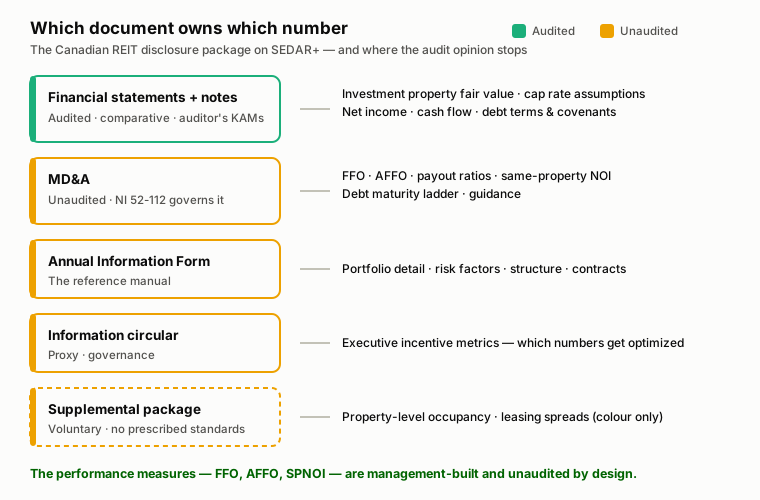
Management's Discussion & Analysis (MD&A). Management's narrative of the results, and — critically for REITs — the home of the numbers the market actually trades on: FFO, AFFO, same-property NOI, Reported NAV per unit, payout ratios, and the debt maturity ladder. The management-constructed measures among these — FFO, AFFO, same-property NOI, Reported NAV per unit, payout ratios — exist nowhere in the audited statements. (The debt maturities are the exception: the schedule itself sits in the audited debt note — see the table in 1.2 — while the MD&A only re-presents it as a ladder.) The MD&A itself is unaudited.
Annual Information Form (AIF). The reference manual: business description, the full property portfolio, risk factors, material contracts, structure diagrams. Updated annually, read rarely, and exactly where you look when you need to understand what the REIT actually is rather than what it earned this year.
Management information circular. Governance, trustee elections, and executive compensation — including which metrics management is paid on. If the incentive plan pays on FFO per unit growth, you now know which number management cares most about presenting well.
Each quarter, the REIT also files interim (unaudited) financial statements and an interim MD&A — condensed and unaudited. An interim review by the auditor (a lower level of assurance than an audit) is common but not mandatory; where none was performed, Canadian rules require a notice to that effect on the statements — so check for it rather than assuming a review happened. This is where new information usually reaches the market first. Most REITs additionally publish a supplemental information package on their own website: property-level tables, leasing detail, debt schedules. Useful, but remember what it is — a voluntary marketing document, not a regulatory filing, with no prescribed standards at all.
1.2 Which document owns which number
The single most useful habit in REIT analysis is knowing, before you open anything, where a given number lives. A surprising amount of wasted effort is analysts hunting for FFO in audited statements (it isn't there) or trusting a supplemental figure that never appears in a filing.
| You want... | Go to... | Audited? |
|---|---|---|
| Investment property fair value, cap rate assumptions | Financial statement notes (investment property note) | Yes |
| Net income, cash flow from operations | Financial statements | Yes |
| Debt terms, maturities, covenants | Notes (debt note) + MD&A (ladder table) | Notes yes, MD&A no |
| FFO, AFFO, payout ratios | MD&A (reconciliation section) | No |
| Same-property NOI | MD&A | No |
| Portfolio detail, risk factors, structure | AIF | No |
| Executive incentive metrics | Information circular | No |
| Property-by-property occupancy, leasing spreads | Supplemental package | No |
Notice the pattern: the headline performance measures the market prices REITs on — FFO, AFFO, same-property NOI, the per-unit series — are management-constructed and unaudited. The exception sits right at the top of the table: investment-property fair values and their cap-rate assumptions live in the audited notes, so the single largest valuation input is audited (for process, not re-derivation). That is not a scandal — it's the design. IFRS produces the audited statements; the analytically decisive REIT measures are management-constructed on top of them, in the unaudited MD&A. Your protection is not the auditor; it's the reconciliation, which is why the next-but-one section covers the rule that governs it.
1.3 The reading order that works for REITs
For an industrial company, you might read income statement → balance sheet → cash flows. For a Canadian REIT that order wastes your time, because the income statement is dominated by fair-value noise (Beginner Course 2) and the headline earnings number is close to meaningless. Experienced REIT analysts read in this order:
First: the investment property note. How big is the portfolio at fair value, what moved it this period, and what cap rates is management marking at? This one note contains the assumptions that drive both the balance sheet and the largest lines of the income statement.
Second: the debt note and the MD&A's maturity ladder. Leverage, cost of debt, what matures in the next 24 months, and at what rates. Refinancing risk is the fastest way a REIT gets into trouble; you want it sized before you look at earnings.
Third: the MD&A's non-GAAP reconciliations. Net income → FFO → AFFO, line by line. This is where you apply everything from Beginner Course 3 — and, from Course I-2 onward, where you'll rebuild the numbers yourself.
Fourth: the income statement — as a valuation signal, not an earnings report. By now you can decompose it on sight: rental revenue and property operating costs (the real business), fair value changes (marks, not earnings), exchangeable-unit remeasurement (an accounting artifact), interest expense (real, and check whether exchangeable distributions are sitting in it).
Last: cash flow from operations. The honesty check. FFO and cash flow from operations will never match — but they should rhyme. A persistent, growing gap between AFFO and actual cash generation is a question that demands an answer.
1.4 NI 52-112: the non-GAAP rulebook
Because the measures that matter are unaudited, Canadian regulators impose disclosure discipline on them. National Instrument 52-112 (Non-GAAP and Other Financial Measures Disclosure, in force for financial years ending after October 2021) requires that any non-GAAP measure in a filing be clearly labelled as non-GAAP, defined, reconciled to the most directly comparable IFRS measure, presented no more prominently than the IFRS measure, and consistent with prior periods — with changes in composition explained.
For the analyst, NI 52-112 is less a compliance topic than a free quality screen. Every requirement it imposes is something you can grade an issuer on:
- Is the FFO reconciliation genuinely line-by-line, or does it lean on a large "other adjustments" bucket?
- Does the issuer state where its definition departs from REALPAC's, or leave you to discover it?
- Did any definition quietly change from last year's MD&A? (The instrument requires disclosure of the change — check that the explanation exists and that the prior period was restated onto the new basis.)
A REIT that reconciles cleanly, flags its REALPAC departures, and holds definitions steady is telling you something about management culture. So is the opposite.
1.5 Worked example: a 30-minute first pass on Choice Properties
Example based on Choice Properties REIT's 2025 annual disclosure package (year ended December 31, 2025, C$). Figures as disclosed; this is a workflow illustration, not current analysis.
Here is the first-pass workflow applied to a real package. Choice Properties (TSX: CHP.UN) is a useful specimen because it exhibits nearly every structural feature this track covers: a large exchangeable-unit position, a dominant related-party tenant, and a clean REALPAC-style reconciliation.
Minutes 0–5 — the investment property note. Portfolio carried at fair value; the note discloses weighted-average capitalization rates by asset class — 6.04% overall, with industrial at 5.58% and mixed-use at 5.11% at December 31, 2025. Write those down: in Course I-4 they become the base case you stress. The note also splits the period's fair value change and states how much of the portfolio was externally appraised.
Minutes 5–10 — debt. The debt note gives the instruments and covenants; the MD&A ladder table shows maturities by year. You are asking one question: is there a wall of maturities repricing into higher rates within 24 months, and can retained cash flow plus capacity absorb it?
Minutes 10–20 — the reconciliation. The 2025 income statement shows a net loss of $61.2 million, against net income of $784.4 million the year before. An $845 million earnings collapse? No — the MD&A reconciliation shows the swing is dominated by a $577.8 million unfavourable move in exchangeable-unit remeasurement: the unit price rose, so the liability marked up, so "earnings" fell. (The same mechanics produced Q1 2026's reported $87.2 million net loss alongside $196.0 million of FFO.) Strip the artifacts and the operating story — FFO, rental revenue, occupancy — is stable. Ten minutes with the reconciliation converts a terrifying headline into a non-event.
Minutes 20–25 — the related-party note. Choice's largest tenant is Loblaw, and a majority effective interest in the REIT sits with George Weston Limited — the same group on both sides of the leases. The related-party note plus the AIF tell you what share of revenue depends on that relationship. This isn't hidden; it's disclosed in detail. But an analyst who skips the note prices Choice as a diversified landlord when it is, economically, substantially a single-credit covenant with a shopping-centre portfolio attached.
Minutes 25–30 — the auditor's report. Read the key audit matters. For a Canadian REIT, investment property valuation is almost always a KAM — the auditor telling you, in plain language, which estimate required the most judgment. When the auditor and this course agree on where the soft spots are, believe both.
1.6 Red flags in the package itself
Before any ratio work, the package can warn you on its own terms:
A non-GAAP definition changed. Permitted under NI 52-112 with disclosure — but why did it change, and did the change flatter the metric? A sustaining-capex reserve lowered the year AFFO got tight is a finding.
The reconciliation got vaguer. Line items merged into "other," or a new adjustment appearing every quarter while being described as non-recurring.
Supplemental figures that don't appear in the MD&A. If a flattering metric lives only in the unregulated document, ask why it didn't survive contact with the filing.
Subsequent events doing heavy lifting. Material dispositions, financings, or covenant amendments dated after year-end but before filing — the freshest information in the package, buried in the last note.
A new KAM, or a going-concern paragraph. Rare, loud, and never to be read past.
Analyst callout — the traps in this course
Trusting the supplemental. It has no prescribed standards, isn't filed, and can define metrics however management likes. Use it for property-level colour; never source a headline number from it without finding the same number in the MD&A.
Reading the income statement first. For a Canadian REIT this anchors you on the least meaningful number in the package. The reading order in 1.3 exists because fair-value and exchangeable-unit noise (Beginner Course 2) will dominate the headline in most periods.
Assuming "audited" covers everything in the annual report. The glossy annual report PDF wraps audited statements and an unaudited MD&A in one cover. The auditor's opinion stops at the statements and notes.
Skipping the circular. Compensation metrics are the cleanest available signal of which numbers management will optimize. Two minutes in the incentive-plan table repays itself.
Key terms
| Term | Definition |
|---|---|
| SEDAR+ | The CSA's public filing system for Canadian issuers; successor to SEDAR (2023). All required disclosure lives here, free. |
| MD&A | Management's Discussion & Analysis. Unaudited narrative filed with the statements; home of FFO, AFFO, same-property NOI, and the debt ladder. |
| AIF | Annual Information Form. Annual reference document: business description, portfolio, risk factors, material contracts. |
| Information circular | Proxy document for the unitholder meeting; contains governance and executive compensation detail. |
| Supplemental package | Voluntary, unregulated investor package on the issuer's website; property-level detail with no prescribed standards. |
| Interim statements | Unaudited condensed quarterly statements and MD&A; where new information usually appears first. |
| NI 52-112 | Canadian rule governing non-GAAP disclosure: label, define, reconcile, no undue prominence, consistency across periods. |
| Reconciliation | The line-by-line bridge from an IFRS measure (net income) to a non-GAAP measure (FFO/AFFO). Your primary quality screen. |
| Key audit matter (KAM) | Matter the auditor judged most significant in the audit, described in the auditor's report. For REITs, typically investment property valuation. |
| Subsequent events note | Disclosure of material events after the balance sheet date but before filing. The freshest information in the package. |
| Related-party note | Disclosure of transactions with related entities — for some REITs (e.g., Choice/Loblaw/Weston), the economic heart of the story. |
Knowledge check
1. You need a REIT's AFFO payout ratio and its cap rate assumptions. Which documents do you open, and which figure is audited?
The AFFO payout ratio lives in the MD&A (unaudited). Cap rate assumptions live in the investment property note to the financial statements (audited). This asymmetry is the central fact of REIT disclosure: valuation inputs are audited; the performance measures the market trades on are not.
2. A REIT's annual report shows a large net loss, but its FFO grew. Using the Choice Properties example, what is the most likely explanation and where do you confirm it?
Most likely a fair-value or exchangeable-unit remeasurement effect: Choice reported a $61.2M net loss in 2025 — against $784.4M of net income the prior year — driven by a $577.8M unfavourable exchangeable-unit swing as its unit price rose, while operating results were stable. Confirm in the MD&A's net-income-to-FFO reconciliation, which isolates each artifact line by line.
3. What does NI 52-112 require of an issuer presenting FFO, and how does an analyst use the rule as a quality screen?
It must label FFO as non-GAAP, define it, reconcile it to the most comparable IFRS measure (net income), give it no more prominence than the IFRS measure, and apply it consistently — explaining any change in composition. The screen: grade the reconciliation's granularity, check whether REALPAC departures are stated, and compare definitions against the prior year's MD&A for quiet changes.
4. Why should the supplemental information package be treated differently from the MD&A, when both are unaudited?
The MD&A is a regulatory filing subject to NI 52-112's discipline and CEO/CFO certification; the supplemental is a voluntary website document with no prescribed standards. Both are unaudited, but only one has rules. Use the supplemental for granular colour; source every headline number from a filing.
5. In your 30-minute first pass, why do the investment property note and debt note come before the income statement?
Because they contain the assumptions and risks that drive the income statement. The fair-value marks (cap rates) generate the largest income statement lines, and the maturity ladder defines refinancing risk that no earnings figure reveals. Reading the income statement first anchors you on a number that fair-value noise makes nearly meaningless for a Canadian REIT — the core lesson of Beginner Course 2.
Sources: Choice Properties REIT 2025 Annual Report and MD&A (year ended December 31, 2025); Choice Properties Q1 2026 interim MD&A; CSA National Instrument 52-112, Non-GAAP and Other Financial Measures Disclosure; REALPAC, White Paper on FFO & AFFO for IFRS. Market-dependent figures (cap rates, remeasurement amounts) are as at the stated reporting dates.
Next in the track: Course I-2 — Rebuilding FFO and AFFO from the Notes.