Level: Intermediate · Duration: ~15 minutes · Course 2 of 6 in the Intermediate track
Prerequisites: Beginner Course 3 (FFO and AFFO concepts) and Course I-1 (the disclosure package). You should already know why FFO exists and where reconciliations live; this course teaches you to take one apart and put it back together.
By the end of this course you will be able to:
- Explain the analytical logic behind each standard REALPAC adjustment, not just its name
- Walk a real issuer reconciliation line by line and identify what each line reverses or adds back
- Classify an issuer's adjustments as REALPAC-standard, defensible-but-issuer-specific, or aggressive
- Distinguish reserve-based from actual-spend sustaining capex and stress-test each
- Restate a divergent issuer's FFO and AFFO onto a REALPAC-consistent basis so peers become comparable
2.1 REALPAC: the benchmark, and why it has to exist
Beginner Course 3 established that FFO is non-GAAP — no IFRS standard defines it. That creates an obvious problem: if every issuer invents its own earnings measure, no two REITs are comparable. REALPAC (the Real Property Association of Canada) solves this with its FFO & AFFO for IFRS White Paper — the industry's standard definitions, most recently updated in January 2022. Nearly every TSX-listed REIT states that it calculates FFO "in accordance with" or "substantially consistent with" REALPAC's definition.
Read those qualifiers the way an analyst should. "In accordance with" is a claim you can audit. "Substantially consistent with" is a flag planted in plain sight — somewhere in the definition, this issuer departs from the standard, and NI 52-112 (Course I-1) obliges them to tell you where. Finding that departure is usually the highest-value ten minutes you can spend on a REIT's MD&A.
The logic of the two measures, restated as construction rules rather than definitions:
FFO answers: what did the portfolio earn this period, ignoring valuation noise? So the rebuild starts from IFRS net income and reverses everything that is a remeasurement rather than an operating result — fair value changes on properties, fair value changes on financial instruments carried at FVTPL, and the accounting artifacts created by liability-classified units.
AFFO answers: what portion of that is sustainable and distributable? So it starts from FFO and subducts the recurring costs of simply staying in business — sustaining capex, leasing costs, and the reversal of non-cash revenue (straight-line rent).
Every line in every reconciliation you will ever read is an application of one of those two rules — or a departure from them. Your job is to know which.
2.2 The FFO rebuild, line by line
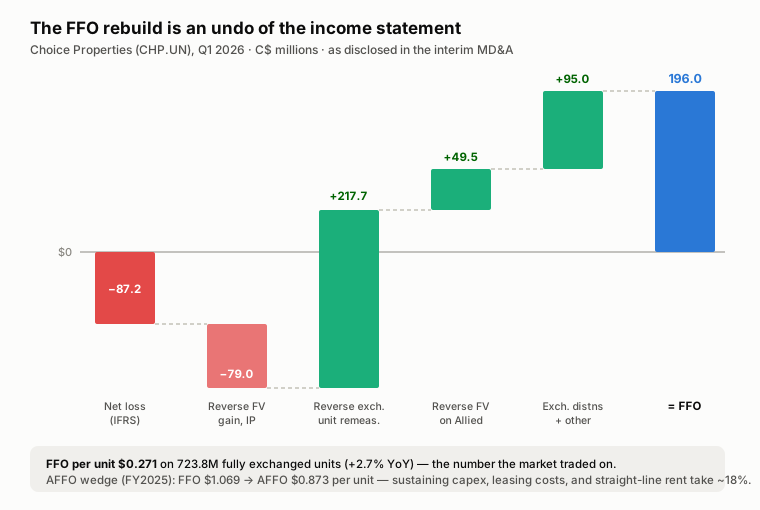
Here is the reconciliation this site used in Beginner Course 3, now with the analyst's commentary each line deserves.
Worked example: Choice Properties REIT, Q1 2026 (three months ended March 31, 2026, C$). Figures as disclosed in the interim MD&A.
| Line | Amount | What it is, and why it moves |
|---|---|---|
| Net loss (IFRS) | −$87.2M | The starting point — dominated by the artifacts below, which is the whole reason FFO exists. |
| Reverse: fair value gain on investment properties | −$79.0M | IAS 40 marks (Beginner 2). A gain is subtracted on the way to FFO — the portfolio rose in value, but that isn't operating income. Direction check: gains reverse out negative, losses reverse out positive. |
| Reverse: fair value adjustment on exchangeable units | +$217.7M | The IAS 32 artifact. The unit price rose, the liability marked up, "earnings" fell $217.7M. Pure accounting; fully reversed. Course I-3 dissects this line. |
| Reverse: fair value change on the Allied investment | +$49.5M | Choice holds units of another REIT, carried at FVTPL. Same logic as the line above: a market-price remeasurement on a financial instrument, not an operating result. REALPAC-standard reversal. |
| Add back: distributions on exchangeable units + other items | +$95.0M | The bucket line — see below. |
| FFO | $196.0M | |
| Weighted average diluted units (fully exchanged basis) | 723.8M | Includes exchangeable units in the denominator — mandatory, since their distributions were just added back to the numerator. |
| FFO per unit, diluted | $0.271 | +2.7% year over year — the number the market actually traded on that quarter. |
Now the intermediate-level move. The beginner lesson presented that +$95.0M as a single balancing line. An intermediate analyst never accepts a bucket. Open the MD&A's full reconciliation table and itemize it. For Choice, the dominant component is distributions paid on exchangeable units: because IAS 32 classifies those units as liabilities, their distributions run through the income statement as interest expense — so they must be added back, exactly as the remeasurement was reversed, to treat exchangeable holders as unitholders rather than lenders. The residue is smaller REALPAC-standard items where applicable: transaction costs on acquisitions, certain deferred tax, amortization of specific intangibles.
The grading rule: a bucket you can fully itemize from the MD&A is fine — the issuer just summarized. A bucket the MD&A also doesn't itemize is an NI 52-112 quality failure and a finding in itself.
Direction discipline. The single most common mechanical error in FFO work is sign confusion. Anchor on this: you are undoing the income statement. Whatever a non-operating item did to net income, do the opposite. Gain flowed in → take it out (negative adjustment). Loss or expense flowed in → put it back (positive adjustment). Every line above obeys this.
2.3 FFO → AFFO: the three sustaining costs
AFFO subtracts what it costs to keep the existing portfolio earning its existing rent. REALPAC groups the deductions into three families:
1. Sustaining capital expenditures. Roof replacements, HVAC, parking lots, elevators — spending that maintains the asset rather than expanding it. The critical fact: sustaining vs value-add is management's own classification of total capex. No standard polices the boundary.
2. Leasing costs. Tenant improvements, tenant inducements, and leasing commissions incurred to keep space occupied. Recurring in economic substance even when lumpy quarter to quarter.
3. Straight-line rent reversal. IFRS recognizes contractual rent escalations evenly over the lease term, so early-year revenue includes rent not yet being collected in cash. AFFO reverses this non-cash component. (Note the asymmetry students miss: straight-line rent stays in FFO and comes out only at the AFFO stage.)
Sizing the wedge — a calculation you can always do. Choice's disclosed full-year 2025 figures: FFO per unit $1.069, AFFO per unit $0.873. The wedge is $0.196 per unit — AFFO is about 18% below FFO. On roughly 724 million fully diluted units, that implies management is charging approximately $140–145 million per year against FFO for sustaining capex, leasing costs, and straight-line rent combined. Now you have a testable number: compare it to the portfolio's gross leasable area (dollars per square foot per year), to actual capex in the cash flow statement, and to what sector peers charge. An implied sustaining charge dramatically below peers' is the signature of an AFFO that flatters.
The two philosophies. Issuers get to the sustaining-capex number two ways, and the difference matters more than any other definitional choice in the sector:
- Actual-spend: deduct what was actually spent this period. Honest but lumpy — a heavy roof year crushes AFFO, a light year flatters it.
- Reserve-based: deduct a normalized allowance (e.g., a fixed dollar amount per square foot or suite per year). Smooth and arguably more economic — but the reserve is a management assumption, and a reserve set below long-run actual spend inflates AFFO every single quarter, forever.
Neither is wrong. The test is the same for both: cumulative reserve (or deduction) vs cumulative actual sustaining spend over 3–5 years. If the cash flow statement's capex persistently exceeds what AFFO charges, the payout ratio is quietly understated. This is the "first thing to interrogate" from Beginner Course 3, now with a procedure attached.
2.4 A field taxonomy of REALPAC departures
When you compare an issuer's definition section against the REALPAC list, departures cluster into five recognizable species. Ordered roughly from benign to aggressive:
1. Presentation departures. The issuer reports "FFO before certain items" alongside plain FFO, with both reconciled. Fine — use the plain one.
2. Genuine one-time add-backs. Severance from an internalization, costs of a terminated transaction. Defensible once. The test is recurrence: an adjustment described as non-recurring that appears in six of the last eight quarters is a recurring cost wearing a costume. Trace adjustments across two years of MD&A — the pattern is impossible to hide from anyone who looks.
3. Upstream capitalization. Not a reconciliation line at all — which is what makes it dangerous. Interest, leasing salaries, and overhead capitalized into development projects never hit the income statement, so they never need adding back; FFO is flattered before the reconciliation even starts. Detection lives in the notes: compare capitalized interest disclosure against total interest paid in the cash flow statement, and watch the ratio over time.
4. Reserve calibration. The reserve-based AFFO species from 2.3, set generously low. Detected by the cumulative-spend test.
5. Definitional drift. The definition itself changes — an item quietly reclassified, the sustaining reserve trimmed — typically in a year when the payout ratio needed the help. NI 52-112 requires the change be disclosed and explained; your job (from Course I-1) is to read this year's definition against last year's, because the disclosure is often technically present and practically buried.
2.5 The restatement: putting every REIT on the same ruler
The payoff skill. When issuer A and issuer B define AFFO differently, comparing their payout ratios is meaningless until you restate one — in practice, restate both to REALPAC. The recipe:
- Start from IFRS net income — never from the issuer's FFO. You inherit their choices otherwise.
- Apply only the REALPAC-standard reversals, taking each figure from the statements and notes (fair value changes from the income statement, exchangeable remeasurement and distributions from the unit and interest notes).
- Refuse every non-standard add-back unless it passes the one-time test in 2.4.
- Rebuild AFFO with your own sustaining assumption. The cleanest approach: replace both issuers' capex figures with a common per-square-foot (or per-suite) reserve appropriate to the asset class, informed by their own 3–5 year actual spend. Deduct actual leasing costs and reverse straight-line rent from the notes.
- Fix the denominator — fully diluted units including exchangeables, from the unit note (Course I-3 makes this rigorous).
Illustrative only: suppose Issuer A reports AFFO of $0.95/unit using a $0.60/sq ft reserve, while its five-year actual sustaining spend averages $1.05/sq ft. Restating at actual spend costs roughly the shortfall times GLA per unit — say $0.09/unit — taking AFFO to $0.86 and the payout ratio from a comfortable 84% to a tight 93%. Nothing about the REIT changed. Only the ruler did. That is the entire point of this course.
Restated numbers are your numbers — label them as analyst-adjusted, show the bridge from the issuer's figure, and keep the issuer's number alongside. Credibility comes from showing the work, a habit this site's methodology page applies to its own metrics.
Analyst callout — the traps in this course
Comparing issuer-defined AFFO across REITs. The single most common analytical error in the sector. Two REITs with identical properties and identical economics can report AFFO payout ratios ten points apart on definitions alone. Restate first, compare second.
Accepting the bucket. "Other adjustments" in a summary reconciliation is fine only if the full MD&A table itemizes it. If the filing itself won't decompose the line, treat the whole reconciliation as low-quality.
Sign errors on reversals. Fair value gains are subtracted; exchangeable-unit losses are added back. If your rebuilt FFO doesn't tie to the issuer's within rounding, check signs before anything else.
Numerator-denominator mismatch. If exchangeable-unit distributions are added back to the numerator, exchangeable units must sit in the denominator. An issuer (or analyst) who does one without the other manufactures per-unit growth from thin air.
Trusting "non-recurring." The word is a claim, not a fact. Eight quarters of MD&A history is the evidence base; read it.
Key terms
| Term | Definition |
|---|---|
| REALPAC White Paper | Industry-standard definitions of FFO and AFFO for IFRS reporters (current version January 2022); the benchmark against which issuer definitions are graded. |
| FFO | Funds from operations: net income with valuation remeasurements and liability-unit artifacts reversed. Operating earnings under fair-value IFRS. |
| AFFO | Adjusted FFO: FFO less sustaining capex, leasing costs, and straight-line rent reversal. The sector's proxy for distributable earnings. |
| Sustaining capex | Spending to maintain existing assets' earning power, per management's own classification. The softest number in the reconciliation. |
| Reserve-based capex | AFFO deduction using a normalized allowance rather than actual spend; smooth, but only as honest as the reserve level. |
| Straight-line rent | Non-cash revenue from averaging contractual rent steps over a lease term; stays in FFO, reversed in AFFO. |
| Leasing costs | Tenant improvements, inducements, and commissions to attract or retain tenants; deducted in AFFO. |
| FVTPL investment | Financial asset (e.g., units of another REIT) carried at fair value through profit or loss; remeasurements are REALPAC-standard FFO reversals. |
| Normalization adjustment | Issuer add-back for claimed one-time items; defensible only if it doesn't recur. |
| Fully-exchanged basis | Unit count including exchangeable units — the mandatory denominator whenever their distributions are in the numerator. |
Knowledge check
1. In the Choice Q1 2026 reconciliation, why is the $79.0M fair value gain on investment properties subtracted while the $217.7M exchangeable-unit adjustment is added back?
Direction discipline: the rebuild undoes what each item did to net income. The property gain increased net income, so removing it means subtracting. The exchangeable-unit remeasurement was a loss (the liability marked up as the unit price rose), so removing it means adding back. Both are remeasurements, not operations; the signs differ only because their income statement effects did.
2. Why must distributions on exchangeable units be added back to reach FFO, and what does that force upon the per-unit calculation?
IAS 32 classifies the units as liabilities, so their distributions are booked as interest expense — but economically they are distributions to unitholders, identical to those on trust units. Adding them back treats exchangeable holders as owners. Consistency then requires the denominator to include exchangeable units (Choice's 723.8M fully diluted count). Adding back the distributions while excluding the units would inflate per-unit FFO.
3. Choice's FY2025 disclosure shows FFO per unit of $1.069 and AFFO per unit of $0.873. What analytical use is the difference?
The $0.196/unit wedge (~18% of FFO) is the implied annual charge for sustaining capex, leasing costs, and straight-line rent — roughly $140–145M on ~724M units. That figure is testable: per square foot against the portfolio, against actual capex in the cash flow statement, and against peers. A wedge materially thinner than peers' flags a flattering sustaining assumption.
4. A REIT deducts a $0.55/sq ft sustaining-capex reserve in AFFO, but its cash flow statement shows five-year average sustaining-type spend near $0.95/sq ft. What is the finding and its consequence?
The reserve is set below demonstrated long-run spend, so AFFO is systematically overstated every period — and because the AFFO payout ratio is distributions ÷ AFFO, an overstated denominator makes that ratio understated, flattering coverage. Restating at actual spend lowers AFFO and raises the true payout ratio, which may reveal that distributions exceed sustainable cash generation. This is finding-grade: it changes the distribution-safety conclusion, not just a decimal.
5. Why must a REALPAC restatement start from IFRS net income rather than from the issuer's reported FFO?
Starting from issuer FFO silently inherits every definitional choice already embedded in it — non-standard add-backs, capitalization effects, sign treatments. Net income is the only common, audited starting point across all issuers; building up from it with only REALPAC-standard adjustments is what makes the restated figures comparable.
Sources: Choice Properties REIT Q1 2026 interim MD&A (three months ended March 31, 2026) and 2025 Annual Report/MD&A (year ended December 31, 2025); REALPAC, FFO & AFFO for IFRS White Paper (January 2022); CSA National Instrument 52-112. Restatement example in 2.5 is illustrative, not issuer data. Market-dependent figures are as at the stated reporting dates.
Previous: Course I-1 — Reading REIT Filings. Next in the track: Course I-3 — Units, Dilution, and Getting Per-Unit Math Right.