Level: Intermediate · Duration: ~15 minutes · Course 3 of 6 in the Intermediate track
Prerequisites: Beginner Courses 1–3 (REIT structure, IAS 32 basics, FFO/AFFO) and Course I-2 (reconciliation mechanics). You already know that exchangeable units are liabilities; this course makes you fluent in every downstream consequence.
By the end of this course you will be able to:
- Inventory every class of unit and unit-like instrument in a REIT's filings and say where each one hides
- Explain, from IAS 32, exactly why trust units stay in equity while Class B exchangeable units land in liabilities
- Construct the correct denominator for any per-unit measure — and prove numerator-denominator consistency
- Decompose per-unit growth into operating growth and dilution, and grade an "accretive" acquisition properly
- Compute market capitalization, Reported NAV comparisons, and leverage metrics that survive the exchangeable-unit distortion
This is the shortest-looking topic in the track and the one that silently corrupts more published REIT analysis than any other. Per-unit errors don't announce themselves; they just make one REIT look 40% cheaper than it is.
3.1 The unit inventory: know your denominator's ingredients
Before any per-unit number means anything, you need the full census of claims on the REIT. For a typical TSX-listed REIT with an umbrella partnership structure, the inventory runs:
Trust units. The publicly traded instrument (the ".UN" on the TSX). Found in the statement of unitholders' equity and the unit capital note.
Class B exchangeable LP units. Units of the REIT's operating limited partnership, held by a vendor or sponsor, exchangeable one-for-one into trust units and typically paired with special voting units so the holder votes as if already exchanged. Economically identical to trust units — same distributions, same upside. Found not in equity but among financial liabilities, at fair value through profit or loss. In Choice Properties' case, this is how George Weston Limited holds the majority of its effective interest — a structural legacy of the Loblaw property spin-out.
Special voting units. Voting shells attached to exchangeables; no economic claim, so they never enter per-unit math. Their existence in the AIF is your tip-off that exchangeables exist.
Compensation units. Deferred units, restricted units, performance units for trustees and executives — settled in units, disclosed in the compensation note, and part of the diluted count as they vest.
Options and warrants, where they exist: diluted via the treasury-stock method, usually immaterial for REITs.
The habit to build: open the unit capital note and the exchangeable-unit note first, write down the period-end and weighted-average count of each class, and only then read any per-unit figure. Thirty seconds of census work immunizes you against the errors in the rest of this course.
3.2 IAS 32 in practice: one exemption, narrowly drawn
Beginner Course 2 introduced the effect; here is the mechanism, because the mechanism tells you which instruments are affected at any REIT you'll ever open.
Most Canadian REITs are open-ended: unitholders can tender units for redemption. A puttable instrument is, by default, a financial liability under IAS 32 — the issuer can be required to pay cash. Taken literally, that would put every REIT's units in liabilities and leave the sector reporting zero equity.
IAS 32's puttable exemption (paragraphs 16A–16B) rescues the sector — but it is deliberately narrow: it applies only to the most subordinate class of instruments issued by the reporting entity itself. Trust units qualify: they are the residual claim on the trust. Class B exchangeable LP units fail on both prongs — they are issued by a subsidiary partnership, not the reporting trust, and they are not the trust's most subordinate class. No exemption, so: financial liability, carried at FVTPL, remeasured every period at — this is the key — the market price of the trust units they exchange into.
Two consequences you now own permanently:
Distributions on exchangeables are interest expense. Cash economics identical to trust-unit distributions; income statement geography completely different. Course I-2 already made you add them back to FFO.
The remeasurement inverts performance. The liability tracks the REIT's own unit price, so a rising unit price books a loss. Choice's Q1 2026: units rose, remeasurement −$217.7M, reported net loss $87.2M in a quarter of record FFO. Full-year 2025: a $577.8M unfavourable swing in this one line turned $784.4M of prior-year net income into a $61.2M loss. The better the market likes the REIT, the worse IFRS earnings look. Any screen, model, or journalist ranking Canadian REITs on net income growth is ranking them substantially on inverted unit-price momentum.
Edge case worth knowing: a handful of Canadian real estate funds fail the exemption for their main units too (structure-specific — usually multiple unit classes) and report no equity at all, just "net assets attributable to unitholders." Same analysis applies; the geography is just more extreme.
3.3 The denominator problem
Every per-unit measure is a fraction, and Canadian REIT structures give you three ways to build the denominator:
- Basic trust units (weighted average) — what the statements use for IFRS per-unit figures.
- Diluted trust units — adds vested compensation units and in-the-money options.
- Fully exchanged / fully diluted — adds exchangeable Class B units, as if all exchanged today.
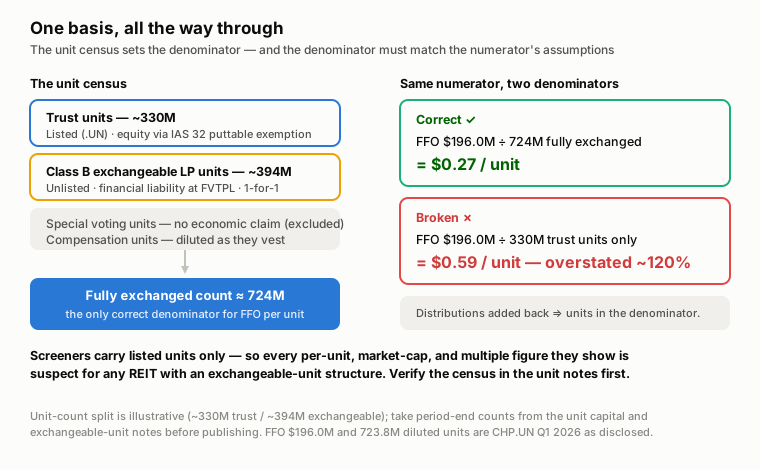
The rule from Course I-2, now stated as law: the denominator must match the numerator's assumptions. FFO adds back exchangeable-unit distributions — treating those holders as owners — so FFO per unit must divide by the fully exchanged count. Choice's disclosed 723.8M weighted-average diluted units is exactly this: fully exchanged basis.
Watch what breaks when the rule is violated. Illustrative figures (using a Choice-like structure — roughly 330M trust units and roughly 394M exchangeables making the ~724M total):
| Calculation | Numerator | Denominator | Result |
|---|---|---|---|
| Correct | FFO $196.0M (exch. distributions added back) | ~724M fully exchanged | ~$0.27/unit ✓ |
| Broken | Same $196.0M | ~330M trust units only | ~$0.59/unit — overstated ~120% |
| Also broken | FFO without the distribution add-back | ~724M | Understated — penalizes the REIT twice |
The "broken" row is not a strawman. It is precisely what happens when someone pulls FFO from an MD&A and a unit count from a stock screener — because screeners typically carry listed (trust) units only. Exchangeables aren't listed, so data vendors miss them, and every downstream per-unit and valuation figure inherits the hole.
The same discipline applies to Reported NAV per unit (adjusted equity ÷ fully exchanged units — see 3.5) and to payout ratios (distributions on all units ÷ AFFO built on the fully exchanged basis). One basis, all the way through, every time.
3.4 Per-unit growth vs dilution: the only scorecard that matters
A REIT can grow FFO forever without creating a dollar of value. Issue units, buy buildings, repeat: total FFO rises mechanically. The unitholder's question is always per-unit: did my slice grow?
Decompose it explicitly. Per-unit growth ≈ total-FFO growth − unit-count growth. Illustrative: a REIT grows total FFO 8% but grew its fully exchanged unit count 12% through an equity raise and DRIP; per-unit FFO fell ~4%. Management's press release will lead with the 8%. Your job is the −4%.
Where quiet dilution comes from: equity issuances (especially bought deals priced at a discount), the DRIP (units issued at a small discount every month, compounding), unit-settled compensation, and units issued as acquisition currency. All disclosed; none headlined. The unit capital note's year-over-year roll-forward is the dilution ledger — read it annually for any REIT you follow, and keep a five-year series of per-unit FFO, AFFO, and Reported NAV. That series is the truest single picture of management's capital discipline in the sector.
The "accretive acquisition" trap deserves its own paragraph. Accretive to FFO per unit merely means the acquisition cap rate exceeds the blended cost of the funding — and since debt is usually the cheap component, almost any deal financed with enough leverage screens "accretive." The bar that matters is different: if the REIT issues units below Reported NAV per unit to buy assets at market value, it destroys Reported NAV per unit even when FFO per unit rises (and because Canadian REITs carry investment property at IAS 40 fair value, Reported NAV per unit is a fair-value yardstick, not a stale-cost one). Grade every equity-funded deal twice: once on FFO accretion (management's frame) and once on Reported NAV per unit (the owner's frame). They disagree more often than IR decks suggest.
3.5 Market cap, Reported NAV, and leverage without the distortion
The exchangeable structure bends three more calculations. All three fixes are one idea: undo IAS 32 — treat exchangeables as equity, consistently.
Market capitalization. Price × fully exchanged count. Using listed trust units alone understates a Choice-like REIT's equity value by more than half — 330M listed units vs ~724M real claims (illustrative split; period-end counts are in the unit notes). This error flows straight into index weights, "market cap" screens, and P/FFO multiples computed from vendor data. When a Canadian REIT looks bizarrely cheap on a screener, check for exchangeables before celebrating.
Book equity and Reported NAV. Reported IFRS equity excludes the exchangeable liability, so it understates the true residual claim. Adjusted equity = reported equity + exchangeable-unit liability (which, helpfully, is carried at the market value of the units it converts into). Divide by the fully exchanged count for a per-unit figure comparable to peers without such structures. Skip this and a REIT with a large exchangeable position appears to trade at a huge premium to book while its clean-structured peer trades at a discount — pure accounting geography.
Leverage and coverage. Symmetry: if you count exchangeables as equity, remove their liability from debt (debt/GBV and debt/EBITDA both) and remove their distributions from interest expense in coverage ratios — those distributions belong below the line with other distributions, not in the denominator's interest bill. Issuers do this in their own covenant metrics; analysts replicating leverage ratios from raw statement lines routinely don't, and conclude the REIT is wildly over-levered. The debt note and the MD&A's ratio definitions show the issuer's treatment — match it or reconcile to it.
Analyst callout — the traps in this course
Screener unit counts. Data vendors carry listed units. Exchangeables are unlisted. Every per-unit, market-cap, and multiple figure from a screener is suspect for any REIT with an umbrella-partnership history — verify the census in the unit notes before using any of it.
Numerator-denominator mismatch. Add back exchangeable distributions ⇒ include exchangeable units. One without the other manufactures (or destroys) ~2× errors, not rounding errors.
Reading remeasurement as momentum. A worsening exchangeable-unit line means the units performed well. Never let a net-income screen or a headline writer convince you otherwise.
"Accretive" as a value claim. FFO accretion is a financing artifact. Units issued below Reported NAV dilute owners regardless of what the deal does to per-unit FFO. Run both tests.
Cross-REIT equity comparisons. IFRS equity is incomparable between REITs with and without exchangeable structures until you add the liability back. This also corrupts debt-to-equity style ratios — prefer debt/GBV, which sidesteps equity entirely (Beginner Course 6).
Key terms
| Term | Definition |
|---|---|
| Trust unit | The REIT's publicly traded residual claim; equity via IAS 32's puttable exemption. |
| Class B exchangeable LP unit | Operating-partnership unit exchangeable 1:1 into trust units; economically identical, but a financial liability at FVTPL because it fails the puttable exemption. |
| Special voting unit | Non-economic voting shell paired with exchangeables; excluded from all per-unit math. |
| Puttable exemption (IAS 32.16A–B) | Narrow carve-out keeping the most subordinate class of the reporting entity in equity; the reason trust units are equity and subsidiary-LP units are not. |
| Fully-exchanged basis | Unit count assuming all exchangeables convert; the correct denominator whenever exchangeable distributions sit in the numerator. |
| Weighted-average units | Time-weighted count over the period, used for flow measures (FFO/unit); period-end count is used for stock measures (Reported NAV/unit). |
| DRIP | Distribution reinvestment plan; issues units (often at a small discount) monthly — a slow, compounding source of dilution. |
| Bought deal | Underwritten equity raise priced at a discount to market; the fastest way REITs issue units below Reported NAV. |
| Accretion | Increase in per-unit FFO from a transaction; a financing artifact, not proof of value creation. |
| Adjusted book equity | Reported equity + exchangeable-unit liability; the comparable equity base across structures. |
Knowledge check
1. Why are Choice Properties' trust units in equity while its Class B LP units — with identical economics — are liabilities?
IAS 32's puttable exemption applies only to the most subordinate class of instruments issued by the reporting entity itself. Trust units are the trust's residual class, so they qualify. Class B units are issued by the subsidiary limited partnership and are not the trust's most subordinate class — they fail both prongs, defaulting to financial-liability treatment at FVTPL.
2. Choice's units rallied in Q1 2026. Trace the effect through the income statement and explain why reported net income fell while FFO grew.
The exchangeable-unit liability is remeasured to the trust units' market price, so the rally booked a $217.7M loss, driving an $87.2M reported net loss even as FFO reached $196.0M (+2.7% per unit). The remeasurement is an inverted reflection of unit-price performance, which is precisely why FFO reverses it.
3. An analyst computes FFO per unit as $196.0M ÷ 330M listed units = $0.59 and concludes the REIT trades at a bargain multiple. Find both errors.
First, the denominator omits ~394M exchangeable units — the numerator added back their distributions, so they must be included: the fully exchanged count is ~724M, giving ~$0.27. Second, the same omission would corrupt the market cap in the multiple's numerator. The REIT is not at a bargain multiple; the analyst's data is at a bargain level of accuracy. (Unit-count split illustrative; verify in the unit notes.)
4. A REIT announces an acquisition "3% accretive to FFO per unit," funded 60% by a bought deal priced 15% below the analyst's Reported NAV per unit. What two tests apply, and can they disagree?
Test one: FFO accretion — passes by construction, largely because the debt component is cheap. Test two: Reported NAV per unit — issuing equity 15% below Reported NAV to buy assets at market value transfers value from existing unitholders to new ones, shrinking Reported NAV per unit. The tests disagree routinely; the Reported NAV test is the owner's test.
5. When computing interest coverage for a REIT with exchangeable units, what adjustment is required and why?
Remove exchangeable-unit distributions from interest expense (and the corresponding liability from debt). IAS 32 books them as interest, but economically they are distributions to owners; leaving them in overstates the interest burden and understates coverage — while inconsistently treating the same instruments as equity elsewhere in your model. One basis, applied everywhere.
Sources: Choice Properties REIT Q1 2026 interim MD&A and 2025 Annual Report (unit figures and remeasurement amounts as disclosed at the stated reporting dates); IAS 32 Financial Instruments: Presentation, paras 16A–16B; REALPAC, FFO & AFFO for IFRS White Paper (January 2022). Trust/exchangeable unit-count splits in 3.3 and 3.5 are approximate and labelled illustrative — take period-end counts from the unit capital and exchangeable-unit notes before publishing any derived figure.
Previous: Course I-2 — Rebuilding FFO and AFFO from the Notes. Next in the track: Course I-4 — Interrogating Fair Value: Cap Rates, Sensitivity, and Real Estate NAV.