You'll learn: what problem the REIT structure solves, why Canadian REITs are trusts rather than corporations, the tax tests a trust must pass to be a REIT, and how a real one (Choice Properties) is put together.
Assumed knowledge: you can read a basic income statement and know what a dividend and market cap are. No REIT or IFRS knowledge assumed.
1.1 The problem REITs solve
Commercial real estate produces steady rental income, but a single office tower or grocery-anchored plaza costs tens or hundreds of millions of dollars. Before REITs, that income stream was available only to institutions and the very wealthy.
A REIT (real estate investment trust) is a vehicle that pools capital from public investors to own a portfolio of income-producing properties, and passes the rental income through to those investors. Two features define it:
- Liquidity. Units trade on the TSX like any stock. You can own a slice of hundreds of grocery-anchored properties and sell it in seconds.
- Flow-through taxation. A qualifying REIT pays essentially no tax at the entity level on income it distributes. Income is taxed once — in your hands — instead of twice (corporate tax, then dividend tax).
That second feature is the reason for everything unusual you'll see in the rest of this track: the trust legal form, the .UN tickers, the distribution mechanics, and some genuinely strange accounting.
1.2 Why a trust and not a corporation
A Canadian corporation pays corporate income tax before it pays dividends. A trust, under Canadian tax law, can deduct amounts it distributes to beneficiaries — so a trust that distributes its taxable income each year pays little or no entity-level tax.
Canadian REITs are therefore structured as unincorporated, open-ended trusts, created by a legal document called a Declaration of Trust (the trust's equivalent of articles of incorporation — it sets out unitholder rights, trustee duties, and usually caps like a maximum leverage ratio). Choice Properties, for example, describes itself as "an unincorporated, open-ended real estate investment trust established pursuant to the Declaration of Trust under, and governed by, the laws of the Province of Ontario."
Because you own units of a trust, not shares of a corporation:
- You are a unitholder, not a shareholder.
- You receive distributions, not dividends (and they're taxed differently — Course 5).
- TSX tickers carry the .UN suffix: CHP.UN, CAR.UN, REI.UN.
1.3 The SIFT rules and the REIT exception
In the mid-2000s so many Canadian businesses converted to income trusts (to escape corporate tax) that on October 31, 2006 the federal government announced the SIFT rules (Specified Investment Flow-Through) — entity-level tax on publicly traded trusts at roughly corporate rates. Existing trusts were grandfathered until the rules took full effect in January 2011. Most income trusts converted back to corporations.
Real estate trusts got a carve-out: the REIT exception in section 122.1 of the Income Tax Act. A trust that qualifies is exempt from SIFT tax and keeps flow-through treatment. The main conditions, simplified:
- 90% qualified-property test: at all times in the year, at least 90% of the fair market value of the trust's "non-portfolio properties" must be qualified REIT properties (broadly, real property and property ancillary to earning rent).
- 90% revenue test: at least 90% of gross REIT revenue must come from rent, interest, capital-gains dispositions of real property, dividends, royalties, and dispositions of eligible resale properties.
- 75% revenue test: at least 75% must come from the narrower core — rent from real property, mortgage interest, and capital-gains dispositions of real property.
- 75% equity-value test: at all times, real property, cash, and certain deposits/debt must make up at least 75% of the trust's equity value.
- Public-market condition: the units must be listed or publicly traded.
You don't need to memorize the tests. What matters for analysis: a Canadian REIT is a REIT because it passes tax tests, and it structures its business to keep passing them. When a REIT sells its development arm, spins out non-rental operations, or declines a business opportunity a corporation would take, the REIT exception is often why.
Analyst note: failing the exception would make the trust a taxable SIFT — a severe outcome — so compliance is a standing constraint, mentioned in every Annual Information Form under risk factors.
1.4 The actual structure: trust on top, partnership underneath
Very few Canadian REITs hold their buildings directly in the trust. The standard structure is two layers:
- The REIT (trust) — the entity you own units of — sits at the top.
- A limited partnership (LP) underneath holds the properties and operations. The trust owns most of the LP.
Why the extra layer? Chiefly because a partnership lets a property vendor contribute buildings on a tax-deferred basis in exchange for LP units, instead of selling for cash and triggering capital gains tax immediately. Those vendor-held LP units are the exchangeable units you will meet in Course 2 — one of the most distinctive features of Canadian REIT accounting.
Real example — Choice Properties (CHP.UN)
Choice Properties, Canada's largest REIT by market value on the REIT Stack screener (retail/grocery-anchored, ~$11.8B), shows the structure clearly. As of its March 2026 proxy circular:
| Component | Count | Held by |
|---|---|---|
| Trust Units (CHP.UN, publicly traded) | 328.0M | Public + George Weston Ltd (50.7M) |
| Class B exchangeable LP units | 395.8M | George Weston Ltd (all of them) |
| Total, fully exchanged | 723.8M |
George Weston (the Loblaw parent) holds a 61.7% effective interest — mostly not through the public units, but through exchangeable LP units it received when the grocery real estate was contributed to the partnership. Each exchangeable unit converts 1-for-1 into a trust unit, receives the same distribution, and comes paired with a Special Voting Unit so Weston votes as if it had exchanged.
Two practical consequences you'll use constantly:
- Per-unit math must use the fully-exchanged unit count (723.8M, not 328.0M). Choice's own FFO-per-unit calculation does exactly this.
- The market cap on a stock quote can mislead. A quote source multiplying price by only the trust units shows ~$5.4B; the economic entity is roughly twice that. (REIT Stack's screener uses the fully-exchanged figure — that's the $11.8B.)
Sources: Choice Properties 2026 AIF (Feb 18, 2026); 2026 Management Proxy Circular; George Weston Q1 2026 results.
1.5 The Canadian REIT landscape
The TSX lists roughly 35–40 REITs with a combined market value of about C$76 billion (RENX, September 2025), spanning retail, residential (apartments), industrial (warehouses/logistics), office, healthcare/seniors, and diversified. REIT Stack tracks its current active coverage here. Each sector has different lease lengths, tenant risk, and capital intensity — the Sector Guides track covers this; for now, just know that "Canadian REITs" is not one asset but at least six distinct businesses wearing the same legal structure.
Diagram
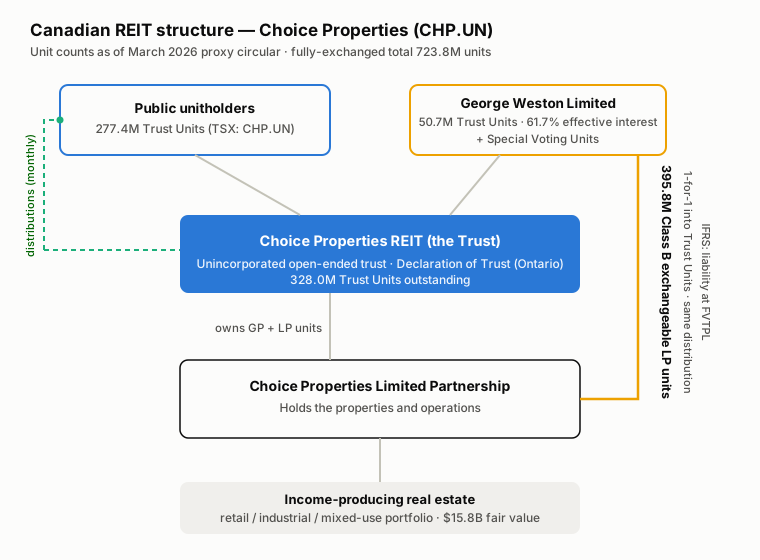
Public unitholders and George Weston at the top; the trust in the middle; the limited partnership holding the properties below, with Weston's exchangeable LP units entering at the partnership level.
Key terms
| Term | Definition |
|---|---|
| REIT | A trust that owns income-producing real estate and qualifies for the REIT exception, making it effectively non-taxable on distributed income. |
| Unit / unitholder | The trust equivalent of a share/shareholder. TSX REIT tickers end in .UN. |
| Distribution | Cash paid to unitholders, usually monthly. Not a dividend — different tax treatment (Course 5). |
| Declaration of Trust | The trust's governing document; sets unitholder rights and operating limits (e.g., maximum leverage). |
| SIFT rules | 2006 rules taxing publicly traded trusts at corporate-like rates; the reason non-REIT income trusts disappeared. |
| REIT exception | The s.122.1 tests (property, revenue, equity-value, listing) a trust must pass to stay flow-through. |
| Exchangeable units | LP units held by a vendor (often the REIT's anchor tenant's parent), exchangeable 1-for-1 into trust units; received in tax-deferred property contributions. |
| Fully-exchanged basis | Unit count assuming all exchangeable units convert. The correct denominator for per-unit metrics. |
Check your understanding
Q1. A colleague says "REITs don't pay tax." What's the accurate version of that statement?
Q2. Why do Canadian REIT tickers end in .UN, and what do you receive instead of dividends?
Q3. Choice Properties has 328.0M trust units trading at ~$16.34. Why is "328.0M × $16.34 ≈ $5.4B" the wrong market cap for comparing Choice against other REITs?
Q4. Why does the REIT-and-LP two-layer structure exist, rather than the trust owning buildings directly?
Q5. A REIT is considering earning substantial revenue from a fee-based property management business serving third parties. Which constraint from this course should come to mind?
Answers
A1. A qualifying REIT pays essentially no entity-level tax on income it distributes to unitholders — the income is taxed once, in unitholders' hands. It must continuously pass the REIT-exception tests to keep this treatment; a failing trust would be taxed as a SIFT at corporate-like rates.
A2. Because they are trusts, not corporations — you hold trust units, and the .UN suffix marks that. You receive distributions, which are a tax mix of other income, capital gains, and return of capital rather than dividends (no dividend tax credit).
A3. George Weston holds 395.8M Class B exchangeable LP units that convert 1-for-1 into trust units and receive identical distributions. On a fully-exchanged basis there are 723.8M units, so the economic entity is roughly $11.8B. Comparing REITs on trust-units-only market cap understates any REIT with large exchangeable-unit positions.
A4. Primarily tax deferral for property vendors: contributing buildings to a partnership in exchange for LP units defers the vendor's capital gain, whereas a cash sale triggers it immediately. That's why the vendor (e.g., Weston/Loblaw) ends up holding exchangeable LP units.
A5. The REIT-exception revenue tests: at least 90% of gross REIT revenue must come from qualifying sources and 75% from the narrow rent/mortgage-interest/real-property-gains core. A large third-party fee business could threaten those thresholds, so REITs keep such activities small or house them carefully.
See it on REIT Stack
- The screener — the current covered REIT universe; note the market cap column is fully-exchanged.
- REIT Stack screener — explore the current active universe and open the configured sample analysis.
Next course: the accounting. Why a Canadian REIT's balance sheet tells you what its buildings are worth today — and why its net income line can show a loss in a good quarter.