You'll learn: the mechanics of REIT distributions, how to assess distribution safety, the three tax characters a distribution can have, how return of capital actually works (ACB math included), and where to hold REITs.
Assumed knowledge: Course 1 (trust structure), Course 3 (AFFO and payout ratios).
5.1 Mechanics: monthly cash, declared per unit
Most Canadian REITs pay monthly (a genuine difference from typical quarterly dividend stocks — and part of the retail appeal). The convention is a declared amount per unit: Choice Properties currently pays $0.065 per unit per month = $0.78 annualized, raised 1.3% with its FY2025 results — its fourth consecutive annual increase.
Yield is annualized distribution ÷ price: for CHP.UN at $16.34, $0.78 ⇒ ~4.8% (the screener shows 4.86% on its own trailing basis and price snapshot). Among the largest covered names, trailing yields currently run from ~2.4% (Boardwalk) to ~6.5% (SmartCentres) — and that spread is information: the market charges a low yield on distributions it trusts and demands a high one where it sees risk or no growth. A REIT yielding far above its sector is usually a market vote of doubt, not a gift. Never rank REITs by yield alone.
Also in the toolbox: DRIPs (reinvest distributions in new units, sometimes at a small discount) and special distributions — one-time, often non-cash year-end distributions declared when taxable income (say, from property sale gains) exceeds cash distributions; units are issued and immediately consolidated so your unit count doesn't change, but you're allocated the taxable income. CAPREIT, for example, declared a $0.90/unit special non-cash distribution in December 2025, characterized as capital gain. If you hold REITs in a taxable account, these can surprise you at T3 time.
5.2 Safety: everything from Course 3, applied
The safety question is answered with the AFFO payout ratio and its trajectory, plus balance-sheet context (Course 6). Recapping through the safety lens:
- AFFO payout under ~90%, stable or falling: retained cash, buffer against a bad year.
- Near or above 100%: the distribution exceeds free cash generation; funded by borrowing or issuance; cut candidate.
- Trajectory beats level. 95% and falling is healthier than 85% and rising.
- History matters. A REIT that has cut before signals how its board weighs the distribution against the balance sheet.
This is codified in REIT Stack's four-verdict system — Covered / Watch / Elevated risk / Insufficient data — which prioritizes the AFFO payout ratio and applies one-way risk escalators (past cuts, elevated debt-to-assets, rising payout trend): red flags can worsen a verdict but never offset each other into a better one. The live screener shows the current mix of verdicts across active coverage.
Dated example: Choice — AFFO payout 88.0% (FY2025), FFO payout 71.9%, four straight increases, verdict Covered. A grocery-anchored portfolio with 98.2% occupancy generates the kind of rent that supports an 88% payout comfortably; the same number in a struggling office portfolio would read very differently. Payout ratios are always sector-contextual.
5.3 Tax character: the part everyone gets wrong
Here's where REITs genuinely differ from dividend stocks. A corporation's dividend is one thing for tax. A REIT distribution is a bundle whose composition you learn each spring on a T3 slip (not the T5 you get for dividends). Three main components:
1. Other income — your share of the trust's net rental income, taxed at your full marginal rate. Critically: REIT distributions are not eligible dividends — there is no dividend tax credit. Dollar-for-dollar in a taxable account, REIT income is taxed like interest, materially worse than an eligible dividend for most investors.
2. Capital gains — flowed through when the trust sells property (or declares gains via a special distribution); only 50% is included in your taxable income.
3. Return of capital (ROC) — the portion exceeding the trust's taxable income, common because capital cost allowance (tax depreciation) shelters rental income at the trust level. ROC is not taxed now; instead it reduces your adjusted cost base (ACB), deferring tax until you sell — and converting what would have been income into a future capital gain. Deferral plus a 50% inclusion rate: for a patient taxable investor, high-ROC distributions are the most tax-efficient kind.
ROC in action (illustrative numbers)
Buy 1,000 units at $20.00 (ACB $20,000). The REIT distributes $1.00/unit for the year, characterized 60% ROC / 40% other income:
| Amount | Tax now | |
|---|---|---|
| Other income | $400 | Taxed at full marginal rate |
| Return of capital | $600 | None — ACB drops to $19,400 ($19.40/unit) |
Sell years later at $22: your capital gain is $22,000 − ACB (reduced by every year's ROC), so the deferred amounts return as capital gains at 50% inclusion. You must track ACB yourself in taxable accounts — brokerage "book values" frequently miss ROC adjustments. (Edge case: ROC can grind ACB to zero; further ROC is then taxed as capital gains immediately.)
Real breakdowns — and why you can't assume
Choice Properties, 2025 ($0.76836/unit): 96.0% other income, 3.8% capital gains, 0.2% ROC. Almost the entire distribution taxed at full marginal rates — Choice is unusually tax-inefficient for taxable accounts, a consequence of its high, stable taxable rental income. Contrast CAPREIT's 2025 special distribution: 100% capital gain. Same asset class, same legal structure, wildly different tax outcomes. The tax character is an empirical fact you look up (issuers publish it every January, and CDS posts it), not a property of "REITs" in general — and it changes year to year with dispositions and CCA.
Sources: Choice Properties tax history page; CAPREIT December 2025 distribution announcement.
5.4 Where to hold REITs
- TFSA / RRSP / RRIF / FHSA: distributions are not taxed and character is irrelevant — no T3, no ACB tracking. For most investors, registered accounts are the natural home, especially for high-"other income" REITs like Choice.
- Taxable accounts: favour high-ROC REITs (deferral + capital-gains treatment); track ACB rigorously; expect T3 slips in late March (they arrive later than T5s — relevant if you file early).
- Non-residents: withholding tax applies (generally 25% on income distributions, 15% on ROC where the trust is Canadian-real-property-heavy) — covered in the Advanced tax track.
This course explains the general tax framework — it isn't personal tax advice; individual situations vary.
Diagram
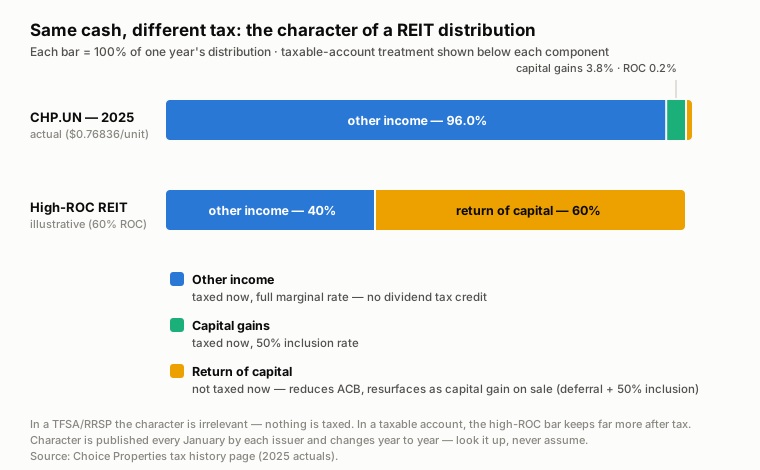
Two stacked bars: Choice's 2025 distribution (96% other income) versus an illustrative 60% ROC distribution — identical cash, very different after-tax results in a taxable account.
Key terms
| Term | Definition |
|---|---|
| Distribution | Monthly cash per unit declared by the trust. A tax bundle of income, capital gains, and ROC — not a dividend. |
| T3 slip | The tax slip trusts issue (vs. T5 for dividends), showing the character breakdown of the year's distributions. |
| Other income | The rental-income component; taxed at your full marginal rate, no dividend tax credit. |
| Return of capital (ROC) | The excess-over-taxable-income component; untaxed now, reduces your ACB, resurfaces later as capital gain. |
| ACB (adjusted cost base) | Your tax cost for the units; reduced by every ROC dollar. You track it — your broker often doesn't, correctly. |
| Special distribution | One-time (often non-cash) year-end distribution pushing out excess taxable income; taxable despite no cash arriving. |
| DRIP | Distribution reinvestment plan — distributions auto-buy new units, sometimes at a discount. |
| Distribution safety verdict | REIT Stack's Covered / Watch / Elevated risk / Insufficient data output, driven by AFFO payout plus one-way risk escalators. |
Check your understanding
Q1. SmartCentres yields 6.5% and Boardwalk 2.4%. Give two structurally different explanations for the spread — one about safety, one that isn't.
Q2. An investor holds CHP.UN in a taxable account for income, at a 45% marginal rate. Using the 2025 character (96% other income), roughly what fraction of the distribution survives tax — and what single change fixes this?
Q3. You receive $600 of ROC on units with a $19,400 remaining ACB. What happens now, and what happens to that $600 eventually?
Q4. A REIT pays a $0.90/unit "special non-cash distribution." No cash hits your account. Are you taxed, and why does the REIT do this?
Q5. Why can REIT Stack's safety verdict move from Covered to Watch but never directly improve because a REIT has, say, excellent occupancy?
Answers
A1. Safety/risk reading: the market may perceive SmartCentres' payout as riskier or growthless (higher required yield), while trusting Boardwalk's — check AFFO payout ratios and trajectories. Non-safety reading: payout policy differs — Boardwalk deliberately retains cash (low payout ratio) to self-fund growth, so its low yield reflects a small numerator by choice, not a high price. Yield alone can't distinguish these; the payout ratio and growth record can.
A2. The 96% "other income" slice is taxed at the full 45% rate (no dividend tax credit), keeping 55% of it; the small capital-gains slice is taxed at half that rate. Weighted: roughly 0.96 × 55% + 0.038 × 77.5% + 0.002 × 100% ≈ 56% of each distribution dollar survives — materially worse than an eligible dividend at the same yield. The fix: hold it in a TFSA/RRSP, where the character is irrelevant and the full distribution is kept.
A3. Now: no tax; your ACB falls $600 to $18,800. Eventually: when you sell, the capital gain is larger by exactly $600 (taxed at 50% inclusion) — the ROC was a deferral and a rate conversion, not an exemption. If repeated ROC ever drives ACB to zero, further ROC becomes immediately taxable capital gain.
A4. Yes — you're allocated the taxable income (here characterized as capital gain, e.g., CAPREIT's December 2025 $0.90 special) even though the distribution was paid in units that were immediately consolidated. The REIT does this when taxable income (often from property-sale gains) exceeds cash distributed: pushing it out preserves the trust's flow-through position (avoiding entity-level tax) without paying out cash it wants to keep.
A5. Because the escalators are deliberately one-way: signals like past cuts, elevated leverage, or a rising payout can only worsen a verdict, never be netted against positives. This asymmetry mirrors how distribution risk works — good occupancy doesn't offset a payout above 100%, but a payout above 100% does undermine good occupancy.
See it on REIT Stack
- The screener — yields and safety statuses side by side; sort by yield and ask, for each high-yielder, what does the market know?
- Methodology — distribution safety — the four verdicts and escalators in full.
Next course: the other side of the balance sheet — debt. The five leverage numbers that tell you whether a REIT survives the next refinancing cycle.